Thursday, June 24, 2010

I think I'm turning Tel Avivi, I really think so...

That was to the tune of "I'm turning Japanese" in case you missed it.

With a little over three months left of my impromptu time here in Israel, I think I've crossed the barrier in terms of turning Tel Avivi. No that's not a typo, residents of Tel Aviv are called Tel Avivis. And I'll try refrain from saying Tel Aviv again for the next few sentences.

Just before I went to the UK I purchased a gorgeous, second-hand-but-almost-brand-new, Trek beach cruiser bicycle. I christened her Sandy for the following reasons; she's pink (metallic magenta to be specific), retro-looking and ridden by an Australian living in the very beachy city of Tel Aviv (oops, sorry). For those who don't get the logic, let me spell it out for you. Pink like the Pink Ladies, retro like Grease, Aussie like Olivia Newton John and finally, where there's a beach there has to be...you got it - sand. Et voila, Sandy.


Considering I hadn't really ridden a bike since my early teen years, this was bound to be a challenge. But I'd decided to get a bike and fully throw myself into proper Tel Aviv lifestyle. You see, along with cats, dogs, dog poo and cafes, this city is full of bicycles. It's the easiest way to get from A to B and you don't have to worry about parking (but you do need to watch out for bike thieves).

So when the opportunity presented itself to get Sandy at a better-than-bargain price, I couldn't turn back. After a few test laps around the park next to the seller's home and a few reassuring words from Doug on my program, I handed over the cash and became the proud owner of this beautiful specimen of machinery.

Riding her home was...hmm...interesting. It took me about an hour to ride the 6km route home. Lots of wobbles, lots of near-misses, lots of dirty looks and "tsks", and lots of jumping on and off when the path was deemed too narrow, or the kerb too high. Never mind the very literal pain I had in my behind once I finally made it back to the apartment. I was hot, sweaty and exhausted but I had done it. I'm not ashamed to admit I was also fairly proud of myself.

Nearly a month has passed and I ride Sandy to work and back almost daily. My confidence is building every day and I can negotiate tight spaces and pesky pedestrians like a pro. Well, most of the time - I haven't crashed into anyone or anything yet. I constantly get stopped on the street by people wanting to know where I bought her. They lavish her with compliments: "
!איזה אופניים יפה" which means "what a beautiful bike!" To which I smile and say "תודה" - thank you.

I've also developed a knack for giving drivers a lot of attitude when they fail to stop properly at crossings. Nothing bad, just a healthy amount of Israeli chutzpah ;) I could almost pass for an Israeli. Until I open my mouth, that is.

Sunday, June 6, 2010

Courage Under Fire

I'm long overdue for a blog update and while I was going to write about our group's wonderful 3-day tiyul to the south of Israel that happened a couple of weeks ago, it seemed more pressing that I talk about the issues Israel is facing at the moment.

Israel is no stranger to bad press and controversy. Everyone and their dog has an opinion (good or bad, and often misinformed) about the Jewish State. And this is fine, I don't have a problem with people having opinions that are different to mine, unless, like in this scenario, their opinions have been formed on anti-Israel reporting, propaganda and years of ignorance.

When the newspapers hit the stands early on Tuesday after the disaster that was Monday morning, the headlines screamed "Bloodshed on the High Seas". I was sitting on the train on my way to Brighton and saw the front page of The Guardian with an equally dramatic headline and asked the passenger opposite me if I could have a look. After reading the front page I passed it back to him and clearly looked shocked, but not for the reasons he thought because he said to me, "yeah, it's pretty bad huh?"

I've gone from being sad to frustrated to plain old mad with the way the Gaza flotilla incident has been reported across the world. First we hear it's 19 people killed, then 15, then 10. I believe the final number is nine now? The world is told how Israel "stormed the flotilla" without being given the surrounding circumstances leading up to the soldiers coming on board. In the race to have their articles out first, the truth and all the facts got lost along the way. People read one article, from early on in the piece, and think they're experts on the matter.

I've had several discussions with people I've encountered here in England about the topic, and they just don't have all the information because they read just one paper, or one source, rather than trying to get the whole picture. No one wants to give Israel a chance, and all the Israel-haters start to crawl out of the woodwork again because they feel they can freely criticise Israel at these times without reproach. Because why should they get in trouble when the reporters and politicians don't get reprimanded for their uninformed accusations?

This is nothing new for Israel, or for the Zionist/pro-Israel Jews out there who have been fighting the bad publicity battle in the Diaspora. So the struggle continues. The best thing to do is to arm yourself with knowledge and facts. Don't fight back with mud-slinging or get too emotional. As my dad once told me, knowledge is power, and the most effective way to combat the nay-sayers is to throw facts at them, because they can't argue with fact. The truth will come out eventually and the world will open its eyes and see what we've been seeing all along.

Wednesday, May 12, 2010

So...you like hummous?

Forgive the randomness of the title, it's very late here but I felt compelled to blog now.

Life continues in its odd, counter-intuitive, Israeli way here in Tel Aviv and I've again had many reminders of how small the world really is. For example, I met an Israeli by chance through an Aussie guy who's living here for now, and he met this Israeli guy totally randomly in Jerusalem at Machane Yehuda. So this guy is telling me he was getting advice from friends and cousins about where to go when he finishes army and how they all say he has to go to Australia, and how his 1st cousin went to Australia and he's been living there for 4 years now because he met a girl and they're getting married next month. I said, "oh that's nice, are they getting married in Israel?" And he says that they are, so then I asked "what's your cousin's name?" and he says Amit. "Amit *****?" I ask...and he stops dead in his tracks and looks at me like I'm crazy and says "yes?! how did you know?" and I tell him that the Aussie girl Amit is marrying is an old friend of mine who I've known since we were 5 and I'll be at the wedding too! The world is shrinking daily in this little country.

We went on a siyur (excursion) a couple of weeks ago to the Ayalon Institute and the Palmach Museum. The Ayalon Institute was the site where all of Israel's ammunition from the Independence War was manufactured clandestinely under the guise of a working kibbutz, where even the people who lived and worked there had no idea what was going on beneath them.


After the Ayalon Institute we went to visit the Palmach Museum where we learned about the underground Hagana (defence) in its early stages prior to Israel's establishment in 1948. I feel like every time I go to another site or museum I add another piece to the puzzle that is Israel's history. I am getting a more complete and rounded understanding of what makes this country tick and the mentality of the people who fought and continue to fight for its existence.

Last week, instead of going on a siyur, a few of us opted in to go to the MASA Conference in Jerusalem called "The Next Step". It was intended to show MASA participants what comes next after their programs in Israel - whether they decide to stay on, make aliyah (immigrate) or return to their home countries. I don't think they really achieved that but it was an interesting day regardless as we got to see Natan Sharansky being interviewed by a well-known Israeli TV journalist, and also we got to see...BIBI!


Yes, the one and only Benyamin (Bibi) Netanyahu - Israel's Prime Minister. The line to get through security to get into the theatre to see him took a ridiculous 45 minutes, but he was worth the wait. It was very propaganda-ish, telling the packed theatre that we (the program participants) "are home - welcome home!" to raucous cheers and applause. He was certainly charismatic though. Now I've seen the President and Prime Minister of Israel. Checking off my list as I go along my merry way.

And this week our group had a tiyul (hike) in the North at Mt Meron which has a stunning view and is not far from the Lebanese border.


Once the hike was finished and we'd had lunch we got back on the bus to visit Netua, to see the moshav where Ricky (our program coordinator) grew up to help her brother collect the eggs from his chicken coop. Surprisingly fun, but also stinky.


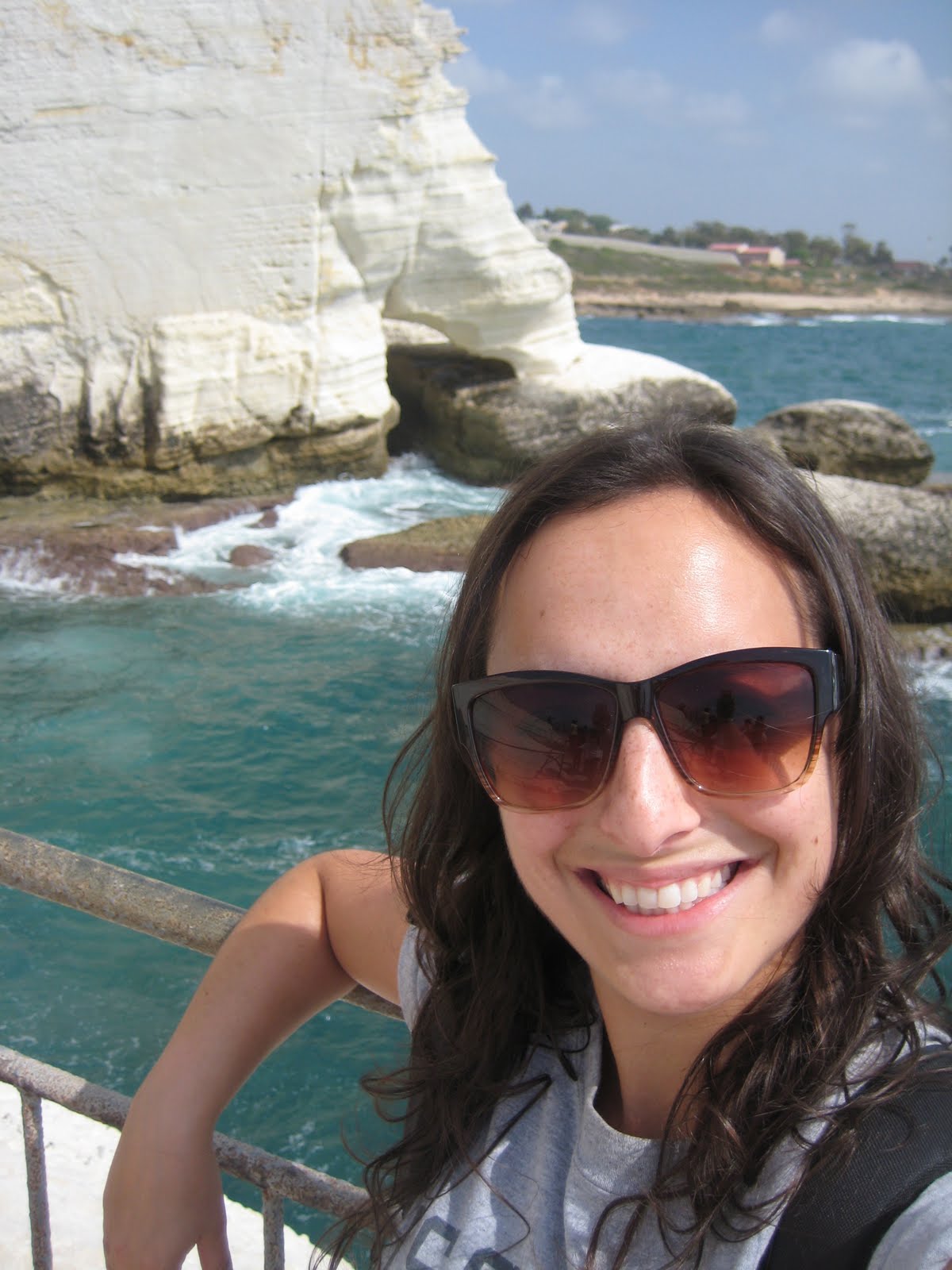
Getting on the bus again we drove to Rosh Hanikra. Now I've been dying to see this place for ages and it lived up to expectations. It's breathtaking and leaves you in awe of how brilliant nature is. Will definitely have to get back up there to spend some more time in this amazing place.


That's it, all up to date now with our siyurim and tiyulim. Next week we have an overnight tiyul in the South and a trip to Eilat (yay!) and we're all pumped for that. Oh, ve od chag (and another festival), Shavuot is next week too, so chag sameach everyone.

Until next time, lehitra'ot.

Sunday, May 2, 2010

Here's a surprising twist...

Don't get me wrong. I absolutely love it here. I love Israel and I love Tel Aviv. But perhaps I'm just a little too sleep-deprived and therefore a little bit of a cranky pants tonight.

So without further ado, here is my top 5 countdown list of things I don't love about Tel Aviv...

5. The dog poo everywhere
People in this city love dogs. I mean, they go bonkers for them. This is a city with a distinct lack of parks and green areas and backyards. So the dogs have to get taken out from time to time. I get that. But the people in this town have an aversion to cleaning up after their dogs. This means that it's near impossible to walk with your head up. It is imperative that you walk around Tel Aviv with your head down just so you can avoid the land mines. It's not pleasant, I know, but do everyone a favour and take a plastic bag with you, will ya?

4. The cats
It's freakish how many cats there are in this city. It's kinda sad, because they're all homeless and they look feral and some are missing tails or ears. But they're disgusting. It's not just their numbers that I find a problem, it's the literal cat fights that go on that we can hear from our apartments. All day, all night. Oh, and also the ever present smell of cat piss. On the upside, I've managed to only bump into one rat (in the shuk at night) so the cats must be doing something right.

3. The massive cockroaches
I'm not a fan of creep-crawlies at the best of times, so the fact that on the pavements (sidewalk for the Americans) of Tel Aviv you can find crawling the biggest cockroaches you've ever seen in your life is horrifying. Quite possibly the scariest thing I've encountered in my time here thus far.

2. The noise pollution
If the sounds of the cats screaming and fighting with each other wasn't bad enough, there is also the music from the music school downstairs that we have to contend with. Emphasis on the word school. These guys are still students and while I'm all for supporting the arts, I don't have to support them at 1am. Plus the fact that we live under a direct flight path for Ben Gurion airport (it's a little reminiscent of The Castle - fast forward to 20 seconds). Along with the balagan that is the car horn. Wow, Tel Avivians have fully surrendered their right to own a car that comes with a car horn. Sheket bevakasha!

And drumroll for number 1...

1. The use of the general public area as a toilet
Now I know that it's infuriating to have to pay a shekel to use a public toilet, but please Tel Aviv, your multitude of cafes and restaurants also have restroom facilities and they do not mind if you use them. I've seen grown men - I'm not even talking about teenagers - pee in full view. I'm talking about a sherut driver, pulling over his cab in the middle of the day to park on the sidewalk (another grievance but luckily I don't drive here) and urinate in a bush in the middle of the street! And the scary thing is that that is not even the most disturbing example of public urination that I have been witness to.
So please Tel Avivians, I'm begging you, please stop treating your city like a urinal. The world is your oyster, not your toilet!

Please feel free to add your pet peeves (sorry, couldn't resist) about Tel Aviv.

Saturday, April 24, 2010

Commemorate then Celebrate

So it's been an interesting month here in Israel. It feels like every two seconds it's a chag again, kind of similar to how April is back home actually. Except instead of Easter and ANZAC Day, it's Pesach and Yom Hashoa, Yom Hazikaron and Yom Ha'Atzmaut. By the way, I've since been told that the sirens on Yom Hashoa and the minute's silence I wrote about last time actually goes for two minutes.

Last Sunday night was the start of Yom Hazikaron, which is the national memorial day for those who have died in combat or as a result of terrorist attacks. The number is a staggering 22,684 since Israel's establishment in 1948. Our group went to Jerusalem for the MASA ceremony which was being held on Ammunition Hill; the site of one of the fiercest battles in Israel's campaign to recapture Jerusalem in the Six Day War in 1967. Close to 2000 people were there at the MASA Yom Hazikaron Ceremony and it was amazing to see so many young, international Jewish people there in one place. There were shnat and machon groups from all the different youth movements (year-long programs in Israel for school leavers), and all around you could hear a cacophony of languages; French, Spanish, Russian, English, Hebrew.


There was an air of excitement, and possibly nervousness, as we didn't know what to expect. In true Israeli fashion, not enough chairs had been set out so in the minutes leading up to the start of the ceremony, chair were being passed along conveyor belt style and set down quickly so everyone would have a seat.

We were then told that in a couple of minutes at 8pm the siren would start and when that happened would everyone please rise. Everyone noted this announcement and continued talking amongst themselves. Then at precisely 8pm, the siren commenced. Without a word, everyone stood up and solemnly observed the minute's silence (this one was definitely one minute and Israelis have not been able to explain to me why there's a difference). As the siren died down, you could hear other sirens in the distance echoing off Jerusalem's hills.


The ceremony then began with a speech from Natan Sharansky who is the chairman of the executive of the Jewish Agency for Israel. He told us of his personal story, of how he was a prisoner in Serbia 30 years ago and how he dreamed of coming to Israel. The father of a soldier who was kidnapped and murdered almost 20 years ago recited kaddish (the mourner's prayer) on behalf of the group which was followed by a beautiful rendition of El Malei Rachamim (a traditional memorial prayer recited at funerals in which God is asked to gather up the soul of the departed for eternal life).


The concept for the ceremony was Life Circles, and the theory that every person in the world is connected by only six other people. A woman came on stage and started telling us about her friend Nir, who was killed in the Second Lebanon War. She spoke about his kind and loving nature, and how he loved his work with young adults here on programs from America, sharing his passion for Israel. The Leonard Cohen song, Hallelujah was sung and a slide show of photos from Nir's life was shown on screen. Once the song was finished, she said a final word about Nir and then said "May his memory be a blessing".

This was the format for each of the seven featured in this ceremony. I won't tell you about each one because it is too hard emotionally for me to go through it again, but what I can tell you is this: there were those who died in the old battles, from the Yom Kippur War or the First Lebanon War, and there were those who died in the recent conflicts, from the Second Lebanon War, and then there was the 24 year old woman who was killed on the 5 bus in Tel Aviv by a suicide bomber. Some of them were Israeli-born, some of them were Olim (the name given to those who make Aliyah). But ALL of them died here. They were all somebody's child. They were all loved, and they are all missed.

When I was on Taglit we went to the military cemetary on Mt Herzl. This is the resting place for Israel's dignitaries; David Ben Gurion (the first Prime Minister of Israel), Golda Meir (Israel's first female Prime Minister and fourth overall) and Theodore Herzl for whom the mountain is named after are all buried here. The Israeli students and soldiers in our group were very emotional after this visit, and they explained to us that when a soldier dies, the whole country grieves. Everyone knows someone who has died, it is inescapable in this country. This is why Israel continues to fight for the release of Gilad Shalit, who was kidnapped nearly four years ago.


When we were at the military cemetery we stopped at one of the graves. We didn't know why we were stopping and then Arie (one of our soldiers originally from the US) came to the front and started speaking. He told us about a friend of his from back in Philadelphia, who he met when he was 14 at a summer camp. His friend's name was Michael Levin. Michael was the only American Israeli soldier to die in the Second Lebanon War. Arie told us about what Michael was like as a teenager, and the things he enjoyed doing, and about how Michael wanted nothing more in the world than to be a paratrooper. He smiled as he spoke about his friend, remembering the happy times they shared, and we all felt like we knew Michael a little bit by the end.

The final person they featured during the Yom Hazikaron ceremony was Michael Levin. I couldn't believe that I was seeing his face on the screen and that I was actually recognising someone. We truly are all connected via six degrees of separation in this world and living here in Israel has only highlighted that. To illustrate this and to bring the ceremony full circle, we were then told that on Mt Herzl, Michael Levin and Nir (the first fallen soldier mentioned) are buried next to each other. The whole time during Nir's presentation I had felt like I had seen his photo before, and I had. After Arie finished talking about Michael we had a few minutes at the cemetery before we had to return to the bus. I looked at the graves next to Michael's and had been looking at Nir's.


Everyone rose again as Hatikva (Israel's national anthem) was about to be played. I have sung this countless times in my life, at school assemblies and other events, but this time was different. I was still crying from watching the presentation about Michael when the opening chords of Hatikva started and when I tried to join in and sing, I found that I couldn't. I was overcome by the emotion of the ceremony and of hearing some 2000 young Jewish adults sing the anthem for the Jewish State. I tried to regain some composure and managed to sing along to the second verse, but I was still shaken by the experience.

I'm not going to launch into a political spiel now but I will say that if the rest of the world could be witness to a Yom Hazikaron ceremony in Israel, then perhaps they would have more compassion. It is not about "us" and "them". It is about Israel maintaining its right to defend itself from hostile enemies. Enemies who do not support the existence of the State of Israel and who want to wipe it off the map. Each of the
22,684 people who have died were real men, women and children. They had lives, they had families, and most of them were just too young, which is the saddest thing of all.

The juxtaposition of this national day of mourning against the celebrations of
Yom Ha'Atzmaut which occur the next night is incredible. They shake off the sadness and get ready to celebrate the anniversary of the declaration of Israel's independence. It's amazing how much one country can sustain in 62 years. Israelis are resilient, and it's only after living here for the past three months that I get it. I get it.

Monday, April 12, 2010

Always remember, never forget.


I don't know if one could say they've "felt" a minute's silence, but just seconds ago, I'd say that I did. Today is Yom Hashoa, the day of remembrance to commemorate the Holocaust and remember those who perished. 

Israelis recognise that their country may not have come into existence had it not been for the Holocaust. The desecration, and attempted annihilation, of the Jewish people certainly expedited the creation of the State of Israel - no one can deny that - and it is not a coincidence that Yom Hashoa, Yom Hazikaron (Day of Remembrance) and Yom Ha'atzmaut (Independence Day) all occur within the same week of each other.

At 10am a siren commenced, I walked to the window of my apartment and stood still. From there I could see that even in my small street, Israel had come to a standstill. Men and women who had been sitting on benches a minute earlier were now on their feet, cars had stopped in the middle of the street with their drivers standing next to their vehicles, engines still running. It was an incredible thing to see and I definitely felt that minute.

Saturday, April 3, 2010

Hayom Yom Huledet!

Well, it's not my birthday today, but it was two days ago. Good on the Israelis for not being the same as the rest of the world and having their own version of "Happy Birthday to You". While there is a Hebrew version of the tune we all know, they also have a song that is more commonly sung here with lots of clapping. I much prefer it actually! I don't know this family...it's just a good example of the song :)

So yes, it was my birthday. For interest's sake, I've now celebrated my birthday in 5 countries; South Africa, Australia, Belgium, England, and now Israel. Yay for me.

I had a great day, complete with cocktails, dancing and cake - yes it was KLP (Kosher le Pesach). Which brings me to my point. Oh the joys of having a birthday smack bang in the middle of Pesach (Passover). It is something to be lamented, topped only by having your birthday and Yom Kippur (Day of Atonement - a day where Jews will fast for 25 hours. No food, no water, nada) fall on the same day. This is a less regular occurrence though, so I wish those Yom Kippur birthday people would stop whinging. My birthday is during Pesach about once every four years, thanks to the festival lasting a whole week, meaning the odds are increased. My poor sister's birthday is in Pesach about three times in five years. That's pretty unlucky.

You'd think that
Pesach in Israel would be more holy, right? Wrong. Apart from some establishments being closed for the duration of the holiday, and supermarkets/convenience stores covering their chometz (non-KLP stuff) shelves, you wouldn't really even know it's Pesach. Restaurants are still busy, bars still sell beer and whiskey, and...people still eat bread!

What the? Did I miss something here? Israel, the Holy Land
, the land to which our ancestors came to because it was promised to them, is distinctly less holy when it comes to keeping Pesach. My theory as to why this is, is because Jews living in the Diaspora are not in Israel (duh Lauren), they feel they have to practise their religion more devoutly than their HL-dwelling counterparts. And the Israelis, purely because they live in Israel, feel they have to do less "Jew-wise" because they're already fulfilling the mitzvah (blessing) of living in Israel. Perplexing, isn't it?

One of the major benefits of being in Israel for Pesach is the fact you only have to do one seder (ritual meal where the story of Exodus is retold). Nobody needs to eat that much food two nights in a row. And, unless you're religious, your seder is substantially shorter than what us Diasporans are used to. I'll drink four cups of wine to that!

The first day of chag (festival) is comparable to Christmas Day. Everything is closed (except AM PM which is like 7Eleven). Even the famous Shuk Ha'Carmel (Carmel Market) is closed and Meital and I were walking back from the beach when I noticed this. This major junction in Tel Aviv, which is normally bustling and packed with people, was almost completely void of people. It was like a ghost town and was very eerie. Melbournians, I guess you could compare it to the Flinders/Swanston intersection not having anyone there, no one outside the station, no one in Fed Square...it's odd, trust me.


Only a few more days left of Pesach before it's done and dusted for another year. How time flies. It was pretty cool doing the seder when I've only just been to Egypt. Look at that, I relived the Exodus ;)

Final thought for this blog...
It goes without saying that a seder in Israel with an Israeli family will be conducted in Hebrew. I am still learning and while I'm progressing, I'm still a novice when it comes to the language. So I could follow the proceedings thanks to having done this twice a year, every year, since I was born, but I was still a bit lost. Until they started singing the songs that accompany the story. I could sing every song, as most had the same tune that we use in Australia, which left me with the biggest smile on my face. While we were singing and clapping, I was thinking to myself, "this is what binds us". So while my smile was partly due to me enjoying the festive nature of the seder, it was also because I was loving the fact that no matter where you come from, no matter how you've been brought up, no matter what your background, be it Ashkenazi ( Eastern European) or Sephardi (Spanish/Middle Eastern), a Jew is a Jew. And we all celebrate these chagim (festivals) around the world, on the same day, with the same rituals. And that's a beautiful thing.

http://www.ynet.co.il/articles/0,7340,L-3867776,00.html